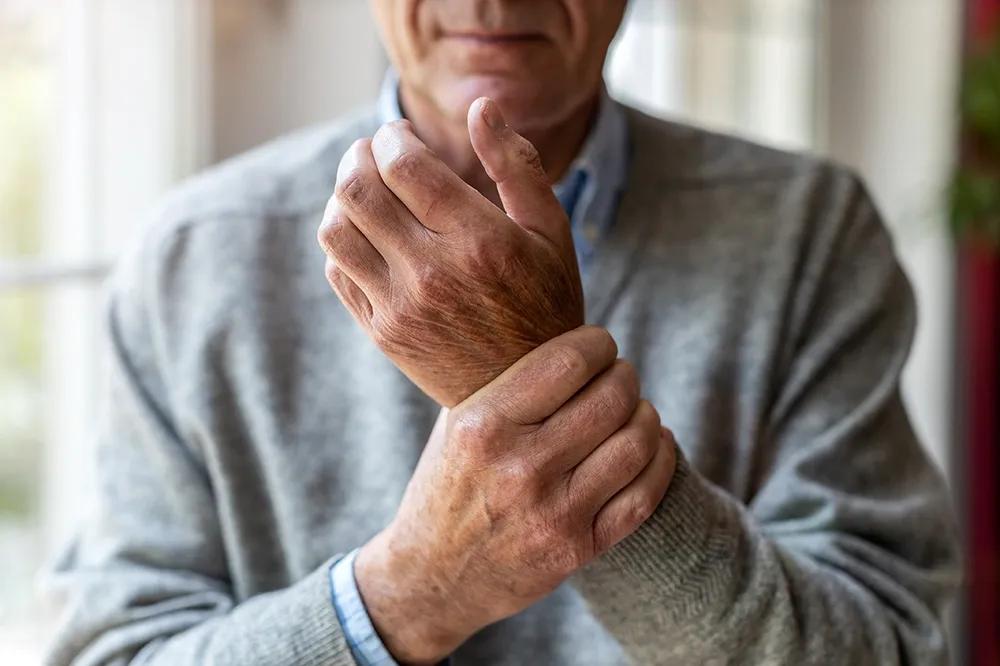
A clumsy fall while cushioning with the hands, a brutal shock during a sports session or a simple wrong movement, and that's the immediate pain. A wrist sprain, often minimized and mistaken for a simple "strain", is a trauma that requires special attention.
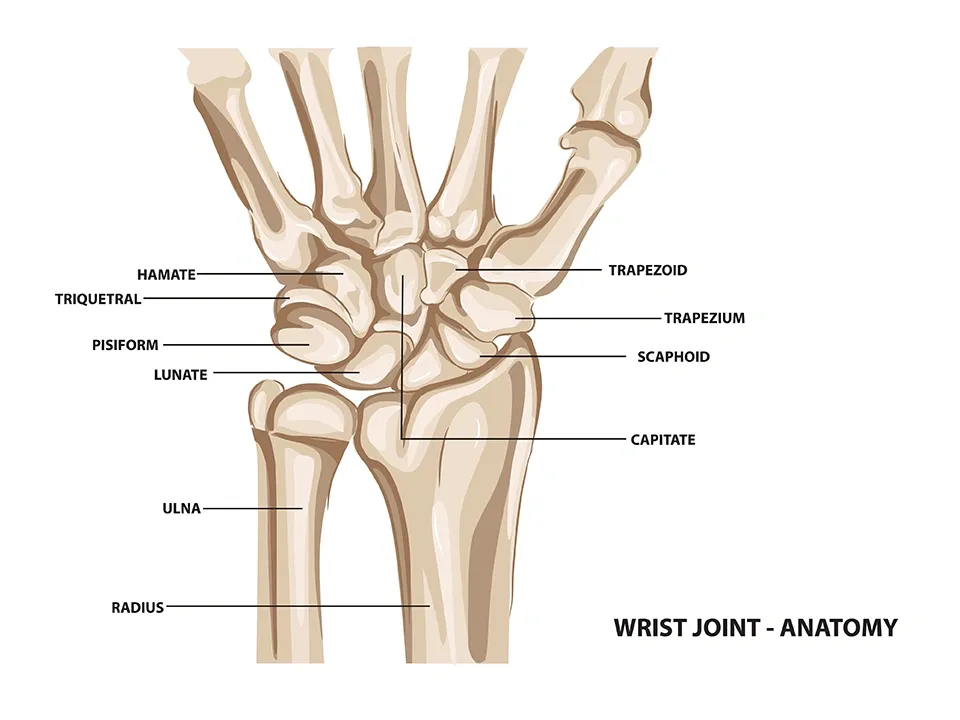
The wrist acts as an essential bridge between your forearm (made up of the radius and ulna) and your hand. At the heart of this structure are eight carpal bones, strategically distributed in two rows (proximal and distal)1.
How does a wrist sprain occur?
All of these small bones are solidly stabilized by a complex network of ligaments. A sprain occurs when these ligaments experience abnormal tension: stretching, twisting or tearing. This trauma often follows a sudden movement, a fall on the hand or an excessive load1.
Among the many structures of the joint, two ligament areas are particularly exposed to injury :
The scapholunar ligament: its injury is the most common cause of carpal instability (which often results in pain and a feeling of a "loose" wrist)1.
The triangular fibrocartilaginous complex (TFCC): it is located on the ulnar side of the wrist, i.e. on the side of the little finger. Itplays a fundamental role as a shock absorber and stabilizer1.
What are the symptoms of a wrist sprain?
A wrist sprain is most often manifested by pain, swelling, bruising, tenderness to the touch and limitation of the movements of the wrist2. Some people also experience a cracking or tearing sensation at the time of the injury, as well as warmth around the wrist2. Even if the symptoms seem mild, ligament damage may be present.
The 3 stages of severity of a wrist sprain
Not all sprains are created equal. In orthopedics, the severity of a wrist sprain depends directly on the extent of the damage to the ligaments. To make an accurate diagnosis and adapt treatment, doctors generally classify this injury into three distinct grades :
Grade 1 (Mild Sprain): at this stage, the ligaments have undergone a simple stretch, but there are no tears2.
Grade 2 (Moderate sprain): the ligaments are partially torn. This type of injury may be accompanied by some loss of function and mobility of the joint2.
Grade 3 (Severe sprain): this is the most significant trauma. The ligament is completely torn. Sometimes the ligament is even completely torn from its bony attachment point. When it is torn off, it can take a small piece of bone with it: this is called an avulsion fracture2.
Certain situations increase the risk of wrist sprain
Certain situations and activities increase your exposure to this type of injury.
Here are the main risk factors to be aware of:
Winter weather conditions: periods of ice or snowfall are conducive to sprains, often caused by a slide where the person tries to cushion themselves by landing on an outstretched arm3.
Sports participation: among athletes, wrist or hand injuries, including sprains, account for 3% to 9% of all sports injuries3. Sprains are particularly common in athletes playing American football, basketball or baseball. In addition, at least 36 Olympic disciplines are associated with an unusually high rate of wrist sprains, such as boxing, volleyball, ice hockey, wrestling and judo3.
Snow sports: falls are a very common cause of sprains in snowboarders. In skiers, the risk is increased if the fall occurs while the athlete is still gripping his pole or when the latter is still attached to his hand by the strap3.
Sports involving intense twisting or shocking: racquet sports, pole vaulting, and wrestling expose the joint to extreme twisting movements3. High-flying divers may also be exposed to wrist strains, requiring the use of bands or splints to limit its extension3.
Wrist sprain: what to do and how to treat it?
The management of your sprain will depend directly on its degree of severity. The three main recommended treatment approaches are:
Taking painkillers like paracetamol, or nonsteroidal anti-inflammatory drugs like ibuprofen, can help relieve pain and inflammation4. However, if the pain persists, it is imperative to consult a doctor.
2. For moderate sprains: immobilization
Intermediate-grade sprains, especially in athletes, may require immobilization with a wrist splint for 7 to 10 days3.
3. For severe sprains: surgical treatment
If the ligament is completely torn or torn off, surgery may be necessary2,4. This surgery must be followed by a rehabilitation phase:
First, a period of immobilization to protect the repair2.
Then, targeted exercises to restore range of motion and strengthen the wrist2.
Good to know: While it usually takes 8 to 12 weeks for the ligament to heal, a full and permanent recovery can take between 6 and 12 months2. The duration will depend on the severity2.
What is the role of physiotherapist in wrist sprain?
The intervention of the physiotherapist is particularly strategic at two key stages of recovery:
After wearing a splint (immobilization): Prolonged immobilization of a joint may cause some stiffness. The physiotherapist will then set up and accompany you on stretching exercises to help you gradually regain mobility gently2.
After surgery (in some cases of severe sprain): After the period of strict immobilization, the healthcare professional will set up a targeted exercise protocol with two objectives: to restore your range of motion and to strengthen the wrist muscles to stabilize it and prevent recurrences2.
FAQ
In cases of mild wrist sprains, symptoms usually improve within two to three days3. More severe sprains can take several weeks or even months to heal completely3.
It is advisable to consult a doctor quickly if your wrist is very swollen, deformed or if the pain prevents you from moving it normally. These signs may indicate a severe sprain or other injury requiring prompt management3. For a milder sprain, medical advice is recommended if symptoms do not improve within two to three days of injury3.
The diagnosis of a wrist sprain is primarily clinical, but imaging tests can be used in addition. X-rays are typically used as a first-line treatment to check bone alignment and rule out a fracture2. When necessary, the doctor may also order an MRI, CT scan or arthrography2. The latter consists of injecting a contrast medium into the joint in order to obtain a better visualization of the ligaments and structures of the wrist.
No, it is not recommended to leave a wrist sprain without appropriate care. If a ligament injury is poorly managed, the sprain can become chronic and lead to progressive weakening of the bones and ligaments of the wrist. In the long term, this can promote the development of osteoarthritis of the wrist5.
A wrist brace is often recommended to keep the joint at rest and protect the ligaments during healing4. It is usually worn for about three weeks for a mild sprain (grade I) and up to six weeks for a grade IIsprain, depending on the severity and evolution of symptoms6.
When the pain subsides, the use of the splint should be gradually reduced4. It is advisable to remove the splint several times a day to gently mobilize the wrist and avoid stiffness4.
In many cases, a mild wrist sprain can be treated at home with a few simple measures3,4,7: rest, ice application, compression, and over-the-counter pain relievers. A consultation is advised if symptoms do not begin to improve within a few days of starting home treatment7.
May Jr DD, Varacallo MA. Wrist Sprain. [Updated 2023 Aug 4]. In: StatPearls [Internet]. Treasure Island (FL): StatPearls Publishing; 2025 Jan-. Available from: https://www.ncbi.nlm.nih.gov/books/NBK551514/
Sport is a healthy activity. However, it can also lead to injury. One of the most common is ankle sprains (1). This is where the RICE protocol comes in. It is a widely recommended method of first aid (2). It is used for the initial treatment of sports injuries. In this article, we will explore this protocol in detail. We will see how it can be your ally against sports injuries, but not only.
Osteoarthritis of the knee: physical activity at the heart of its management
In osteoarthritis of the knee, regular and moderate physical activity is recommended to alleviate pain and improve mobility. Below are some tips to help you look after your knees by getting them moving.